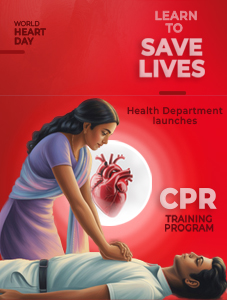
Health Department to Train Life-Saving CPR Skills on World Heart Day
The Health Department is launching an extensive training program to ensure that everyone can learn the most effective emergency first aid to save lives – CPR (Cardiopulmonary Resuscitation). The CPR training program will begin on September 29, World Heart Day. The program focuses on providing training to as many people as possible, including volunteers, Kudumbashree members, drivers, students, and the general public, in a phased manner.
In cases of cardiac arrest or sudden loss of consciousness, providing CPR immediately can greatly increase the chances of survival. When administered correctly and followed by prompt hospitalisation, CPR can save lives. The main objective of the project is to empower people to save lives through scientific and practical training.
The Health Department will prepare a special action plan for this program. Training will be conducted using modern mannequins. A permanent training system will be established in all medical colleges in collaboration with their cardiology departments. A dedicated team will oversee the program, and doctors from the Indian Medical Association (IMA) will also lead training sessions. Additionally, a unified short video on CPR training will be prepared to raise awareness.
What is CPR?
Cardiac arrest stops the flow of blood to vital organs, leading to unconsciousness and other complications. If treatment is not given immediately, brain function ceases, and death may occur. CPR is the simplest and most practical way to prevent this. It helps restore the flow of oxygen-rich blood to the brain and heart temporarily, keeping the person alive until professional medical help arrives.
In the event of a heart attack, CPR can significantly increase survival chances if given immediately. The first step is to check whether the collapsed person is conscious. If unconscious, check for a pulse and breathing. If there is no heartbeat, start CPR immediately. CPR should be performed on the center of the chest, where the heart is located. Place one hand on top of the other, interlace the fingers, and press the chest to a depth of five to seven centimetres. In addition, provide artificial respiration through the mouth. This is a first aid technique that anyone trained in CPR can perform.
CPR training will give people the confidence and skills to save lives in emergencies. This initiative by the Health Department is an important step to raise health awareness and show the value of human life. Even a small training session can help save many lives.